
Building Confidence in Hiring
A 0→1 experience in Me@Campus that helps managers track, manage, and complete hiring tasks — faster, clearer, better.
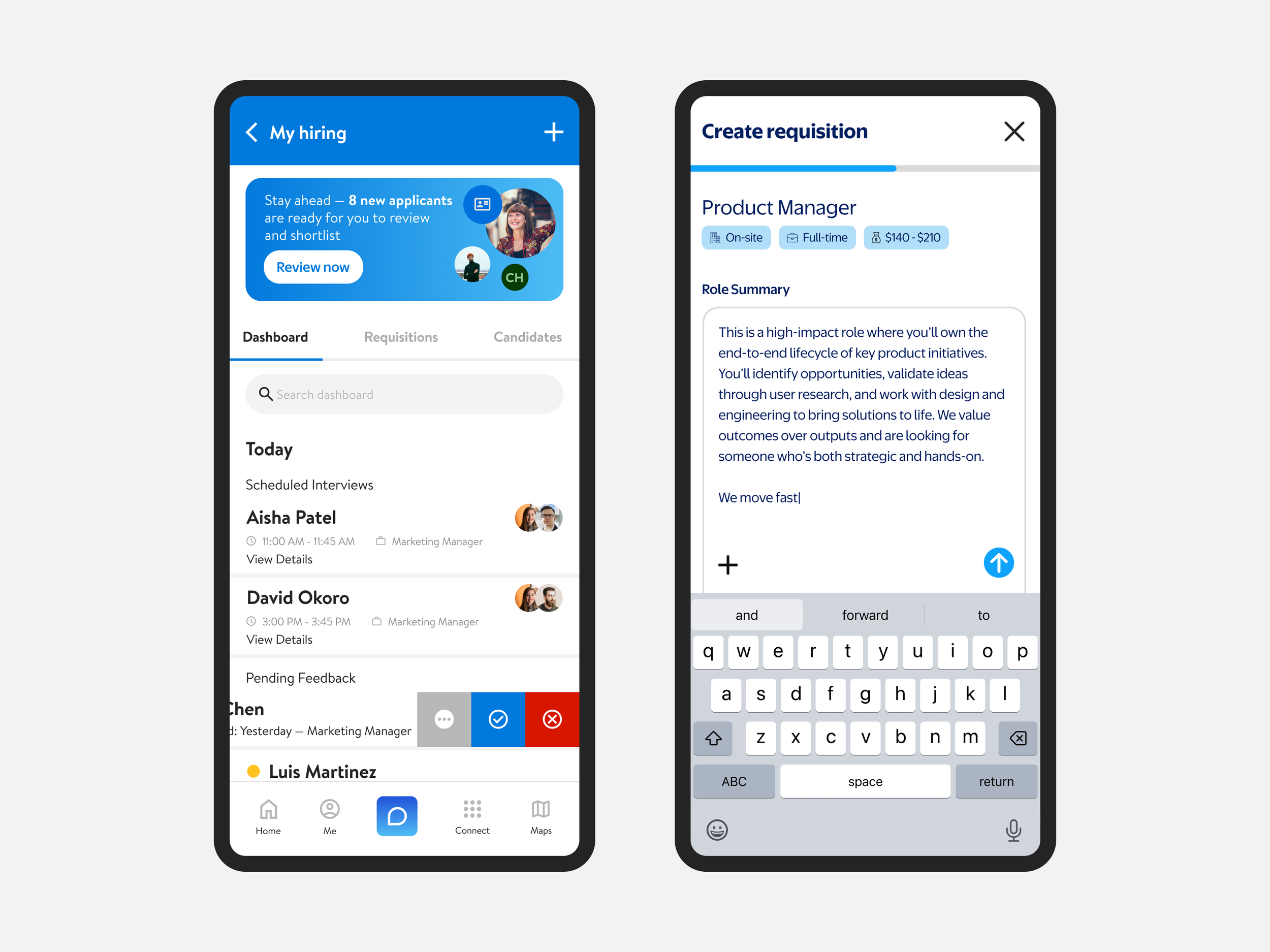
Note: This work is currently under development and covered by a non-disclosure agreement. Specific details have been generalized to honor confidentiality.
Overview
As Walmart prepared for the opening of its new Home Office campus in Bentonville, I led the design of My Hiring Dashboard—a 0→1 experience within Me@Campus intended to help corporate hiring managers track, manage, and complete hiring tasks more efficiently.
This work was initiated alongside the rollout of Walmart’s new brand. At the time, there were no established internal frameworks, tokens, or reusable patterns in place for this product area, requiring many foundational design decisions to be made from scratch. The dashboard served as my first assigned deliverable within a broader hiring modernization effort that I was also supporting.
The goal was to reduce friction, close process gaps, and build trust for hiring managers navigating high-volume corporate hiring by surfacing the right information at the right time.
Problem Statement
Corporate hiring managers were required to navigate multiple disconnected systems and communication channels to manage job postings, interviews, candidate progress, and onboarding steps. There was no single, centralized view of hiring status, making it difficult to identify bottlenecks, take timely action, or maintain accountability across teams.
This fragmentation resulted in duplicated effort, missed follow-ups, and longer time-to-fill for critical roles—particularly as hiring activity increased ahead of the new Home Office opening.
Approach and Process
Research and Strategy
To understand the problem space, I partnered closely with recruiters and corporate hiring managers to map their end-to-end workflows. This included identifying system handoffs, breakdowns in communication, and moments where managers lacked clarity on what action to take next.
Key activities included:
Interviewed corporate hiring managers and recruiters to understand workflows, pain points, and information needs
Identified gaps between recruiting, HR partners, and hiring managers
Synthesized findings into core user needs: visibility, accountability, and clear next steps
UX and Interaction Design
I designed My Hiring Dashboard as a 0→1 initiative within Me@Campus, aligning with Walmart’s broader internal tools that support communication, productivity, and people operations.
Because the dashboard was developed early within a larger initiative, it became clear over time that it represented only one surface of a more complex ecosystem. In hindsight, additional variables—such as how requisitions, candidates, and downstream workflows would be introduced—would have benefited from a broader framing before isolating the dashboard experience. This learning informed subsequent design decisions across the larger project.
Design activities included:
Designed the dashboard experience from the ground up within the constraints of a newly launched brand
Created flows, wireframes, and high-fidelity prototypes that surfaced hiring status, alerts, and quick actions
Ran usability testing with managers to validate clarity, task completion, and cognitive load
Iterated based on feedback from stakeholders across People Product & Design to align with evolving roadmap priorities
Solution
The resulting concept was a streamlined hiring dashboard embedded directly within Me@Campus, giving corporate hiring managers:
A centralized pipeline view of open roles and candidates in progress
Proactive alerts and reminders for actions such as scheduling interviews or providing feedback
Shortcuts to related tasks, including onboarding and internal communications
A consistent experience connected to Walmart’s secure internal HR and productivity ecosystem
Results and Impact
My Hiring Dashboard was prioritized as a foundational component of Walmart’s broader hiring and recruiting modernization roadmap
Once live, the experience is expected to help managers spend less time navigating administrative tasks and more time building and growing teams in the new Home Office
Key Takeaways
Designing a single point of entry for hiring tasks reinforced the importance of visibility and momentum in complex internal workflows. This work also highlighted the value of stepping back to understand ecosystem-wide dependencies before anchoring on individual surfaces—an insight that informed how later phases of the project were approached.