Bible Study
Designing for
Formation
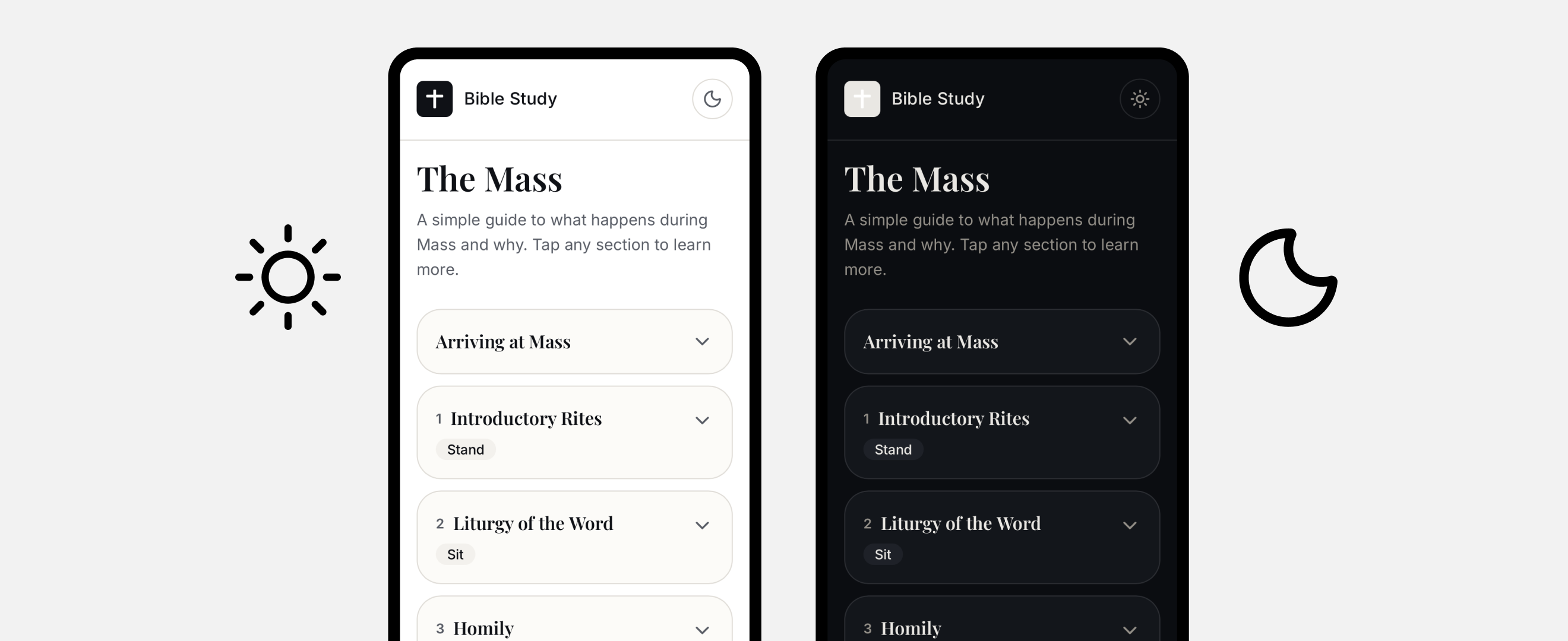
Helping OCIA participants feel at home in the Catholic faith by covering the things every class assumes you already know but never actually teaches.
Why I Built This
As a woman who was raised Catholic, I found myself at one of the lowest points in my life. I felt as though everything around me was falling apart. At the age of 47, I found myself returning to the Church, this time as an adult and entirely on my own.
Much of what I knew came from culture, family traditions, and lived experience rather than from a deeper understanding of Roman Catholic teaching and practice. As I began my OCIA journey, I realized I was not alone. Some participants were coming from other Christian denominations. Some were preparing for marriage. Some were seeking Baptism for the very first time. Our stories were different, but we shared something important: each of us had been led here for a reason.
When I entered OCIA, I was excited to learn more about the Catholic faith. What I did not expect was how much of my learning would happen between classes. The information was there, but it was spread across apps, handouts, and websites. For someone like me—curious, eager to learn, and looking for insight before going deeper—this made the process harder for me.
This is not about replacing OCIA or turning faith into an app. It is about creating a study guide: a supportive, educational companion that could help participants stay oriented as they move through formation.
What I Observed
Days before my Confirmation, I was listening to The Katie McGrady Show on SiriusXM's Catholic Channel when she mentioned a study reporting significant growth among Gen Z and Millennial Catholics. The statistic immediately caught my attention.
I had seen evidence of that growth firsthand.
Throughout the year, our OCIA director often commented on the increase in participation. He shared that the previous year's class had approximately 15 participants and that attendance had grown substantially. Living in Bentonville, Arkansas—home to Walmart's corporate headquarters and a rapidly growing population—I initially assumed this was a local trend driven by the area's expansion.
The more I looked into it, the more I realized it was part of something larger.
Recent reporting from Hallow, based on diocesan data across the United States, found significant increases in adult entrants to the Catholic Church, with many dioceses reporting substantial year-over-year growth. The trend was not isolated to my parish or community.
For me, this became an important validation point. While the project began with my own experience, the data suggested a broader opportunity. As more people enter formation from different backgrounds, experiences, and levels of familiarity with the faith, the need for accessible guidance and ongoing support grows as well.
The question shifted from "Would this have helped me?" to "How might this support the growing number of people beginning their own journey?"
Growth alone, however, was not the only insight.
Before OCIA classes begin in September, our parish offers a Bible study for participants throughout the summer. It was during those sessions that I was introduced to The Chosen. Until then, I had never heard of the series, nor had I considered shows, books, or other forms of media as ways to deepen my understanding of the faith.
Watching The Chosen during my formation journey made the experience richer and more meaningful. It helped bring the stories of Scripture to life in a way that complemented what I was learning elsewhere.
Had I not attended that Bible study, I may never have discovered the series at all.
The same was true for many of the resources and recommendations that were shared throughout the year. They often emerged organically through conversations and community. While that is one of the strengths of the formation experience, it also highlighted an opportunity: how might we make some of those helpful resources easier to discover for people navigating the journey on their own?
What Emerged
As I reflected on my own experience, spoke with other participants, and looked at broader trends, a pattern began to emerge.
The challenge was not a lack of information. The Church already provides an extraordinary amount of guidance, teaching, and resources. The challenge was knowing where to begin and how to stay connected to the journey between classes and beyond.
People were discovering resources through conversations, Bible studies, podcasts, books, websites, and recommendations from fellow parishioners. These moments are valuable. But for someone starting out these conversations don't begin when the journey does.
The solution is not to create more content. It is to create a simple place where the most helpful information could live together.
Sources
- Hallow. (2026). Catholic Church sees massive growth in new members in 2026. hallow.com
- Hallow. (2026). Pray40: The Return — Lent community prayer challenge. hallow.com
- Aleteia. (2026). Hallow Catholic prayer app tops charts at #1. aleteia.org
- ZENIT. (2026). Hallow surpasses WhatsApp and ChatGPT to become the most downloaded app in the Apple Store. zenit.org